Vietnamese coffee, an art of living
From the red basalt soil of the Central Highlands to the small stools in Hanoi's alleys, coffee is far more than a drink: it's the pulse of Vietnam, a pause elevated to the rank of collective ritual. A thick glass on a metal table. The clink of a spoon. The smell of roasted coffee rising into the morning air. In Vietnam, coffee isn't drunk to wake up. It's drunk to linger.
Key figures
Second
largest coffee exporter in the world, behind Brazil
First
producer of Robusta in the world
$8.9 billion
in exports in 2025 (a record)
710,000 ha
of coffee plantations across the Highlands
Botany & terroir
Three varieties, three characters
Vietnam grows three species of Coffea, each tied to a specific terroir. What radically sets the country apart from the rest of the world: its near-total dominance of Robusta, while most major coffee industries bet on Arabica.
🌿 Robusta
Cà phê voi — "elephant coffee"
Grown between 500 and 700 m in the highlands of Dak Lak, Gia Lai and Kon Tum. Caffeine content twice that of Arabica. Aromas of roasted cocoa, damp earth, toasted hazelnut. Dense, lingering crema.
Where Arabica cultivates finesse and fruity acidity, Vietnamese Robusta expresses something more direct, more grounded: a concrete, no-nonsense energy that deeply matches the pace of life in the highlands and the alleys of Hanoi.
≈ 95% of production🌸 Arabica
Cà phê chè — "tea coffee"
Grown at altitude around Dalat (Lam Dong) and in northern provinces such as Son La and Dien Bien. Floral and fruity notes, light, delicate acidity.
Long overshadowed by Robusta, it is now being elevated by a new generation of Vietnamese roasters who showcase its high-altitude micro-lots.
≈ 5% of production
🍈 Liberica / Excelsa
Cà phê mít — "jackfruit coffee"
Extremely rare on a global scale, grown mainly in the south of the country. Large beans, woody aroma, smoky and slightly fruity notes.
Little known outside Vietnam, it remains a precious curiosity: a characterful coffee that artisan roasters blend in to reveal its uniqueness.
global rarity
The basaltic soil of the highlands, a legacy of volcanic activity, slowly releases its minerals to the coffee plant's roots — this is where the aromatic density of Vietnamese Robusta is born.
History
From colony to the world capital of Robusta
Coffee arrived in Vietnam as a product, conceived for foreign economic interests. It emerged as a culture. What happened in between is the whole story of Vietnam: receive, transform, adapt, then create something entirely its own.
1857
French missionaries introduce Arabica
The first Arabica plants arrive in northern Vietnam under French colonization. Coffee remains, at first, a drink reserved for the elite.
1900–1925
Discovery of the Central Highlands
Colonists identify Buôn Ma Thuột and the Dak Lak plateau: fertile basaltic soils, ideal altitude between 500 and 1,000 m. Robusta and Liberica are introduced there — better suited to the subtropical climate.
1946
The birth of egg coffee in Hanoi
Nguyen Van Giang, a bartender at the Sofitel Metropole, invents egg coffee by replacing milk, scarce in wartime. His secret recipe has lived on ever since at Café Giảng, 39 Nguyên Hữu Huân street.
1980s
Đổi Mới: liberalization propels the industry
The Đổi Mới reforms open production to exports. Within a decade, Vietnam goes from a few thousand tons to several million bags.
2001
Vietnam becomes the world's 2nd largest exporter
Buôn Ma Thuột is crowned the "capital of Vietnamese coffee." With 210,000 ha and 30% of national production, the country now weighs on world prices.
2010s–today
The rise of specialty coffee
A new generation roasts high-altitude Arabica micro-lots and reinvents the classics. Recipes like coconut coffee win over Paris, London, Tokyo.
Method
The phin: a tribute to slowness
Four stainless steel parts. Hot water. Ground coffee. And time. The Vietnamese phin hasn't changed in generations — because it never needed to.
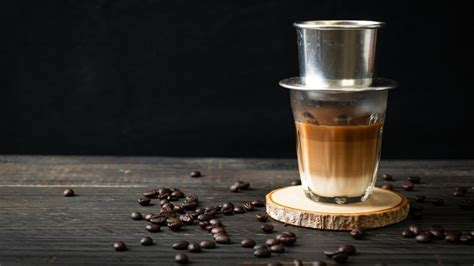

Place the phin on the cup. Add 15–20 g of medium-ground coffee and tamp lightly.

Pour a thin stream of water at 90–95°C to "bloom" the coffee, for 30 seconds.

Top up with 85 ml of water. Place the lid on. The clinking sound is the signal.

Wait 5 to 7 minutes. The brew drips down, dense and dark.

Enjoy it black, or mix it with sweetened condensed milk over ice — and cà phê sữa đá is born.
A descendant of the 19th-century Dubelloire coffee pot, invented by Archbishop Jean-Baptiste de Belloy, the Vietnamese phin has become something entirely its own within its adopted culture. Four stainless steel parts: the base, the body, the press, and the lid. Water filters through drop by drop, over 5 to 7 minutes. It's a meditation, not a recipe.
In many countries, coffee is ordered to go. In Vietnam, the phin demands the opposite. Waiting for a phin coffee means accepting not to rush. Every drop that falls isn't just a step in extraction: it's a lesson in patience, an invitation to inhabit the moment rather than consume it.
Signature recipes
The must-try classics
🥛 Cà phê sữa đá
Iced coffee with condensed milk
The quintessential national drink. Bold Robusta filtered through a phin, sweetened condensed milk, then ice. Bitterness and sweetness in perfect tension. The Michelin Guide calls it a "gem" of Vietnamese coffee.
A good cà phê sữa đá doesn't just refresh. It awakens something: the tinkle of a spoon in a thick glass, the cold condensation on your fingers, the smell of roasted coffee mingling with the air of the sidewalk.
Saigon — everyday habit🥚 Cà phê trứng
Egg coffee
Invented in 1946 at Café Giảng in Hanoi during a milk shortage. Egg yolk whipped with condensed milk and sugar, poured as a golden cloud over bold Robusta.
On the palate, it's close to tiramisu: creamy, soft, almost a dessert. Born of necessity, this coffee illustrates something distinctly Vietnamese: hardship can also produce elegance.
Hanoi — Café Giảng, since 1946🥥 Cà phê cốt dừa
Coconut coffee
Popularized in the early 2010s by Cộng Càphê. A coconut milk granita topped with a strong shot of Robusta. Somewhere between coffee and iced dessert — the gateway to Vietnamese coffee for the whole world.
Urban trend — Hanoi & Saigon🧂 Cà phê muối
Salt coffee
A specialty of the former imperial capital of Huế. A pinch of sea salt in the condensed milk cream. The salt softens the bitterness and reveals unexpected notes, close to salted caramel.
Huế — imperial tradition revisited🍦 Cà phê sữa chua
Yogurt coffee
A pairing born in Hanoi: creamy, French-influenced yogurt poured into a glass, black coffee poured on top. Cold against hot, tangy against bitter. An unlikely balance embraced without hesitation.
Hanoi — neighborhood cafés🫘 Cà phê chồn
Weasel "dropping" coffee
Coffee cherries eaten by the palm civet ferment in its digestive system — gastric enzymes soften the bitterness and create a unique aromatic profile. One of the rarest coffees in the world.
Highlands — rarity and ethical debateBefore the cup
Đắk Lắk, Lâm Đồng, Gia Lai: where coffee begins
Perched between 500 and 1,500 meters above sea level, Vietnam's Central Highlands form one of the most singular coffee terroirs in the world. The soil is basaltic, a legacy of ancient volcanic activity, rich in minerals and with a characteristic brick-red color. The climate alternates dry and rainy seasons with a regularity that suits Robusta perfectly. The result: dense, aromatic beans with a strength few producing regions can match.
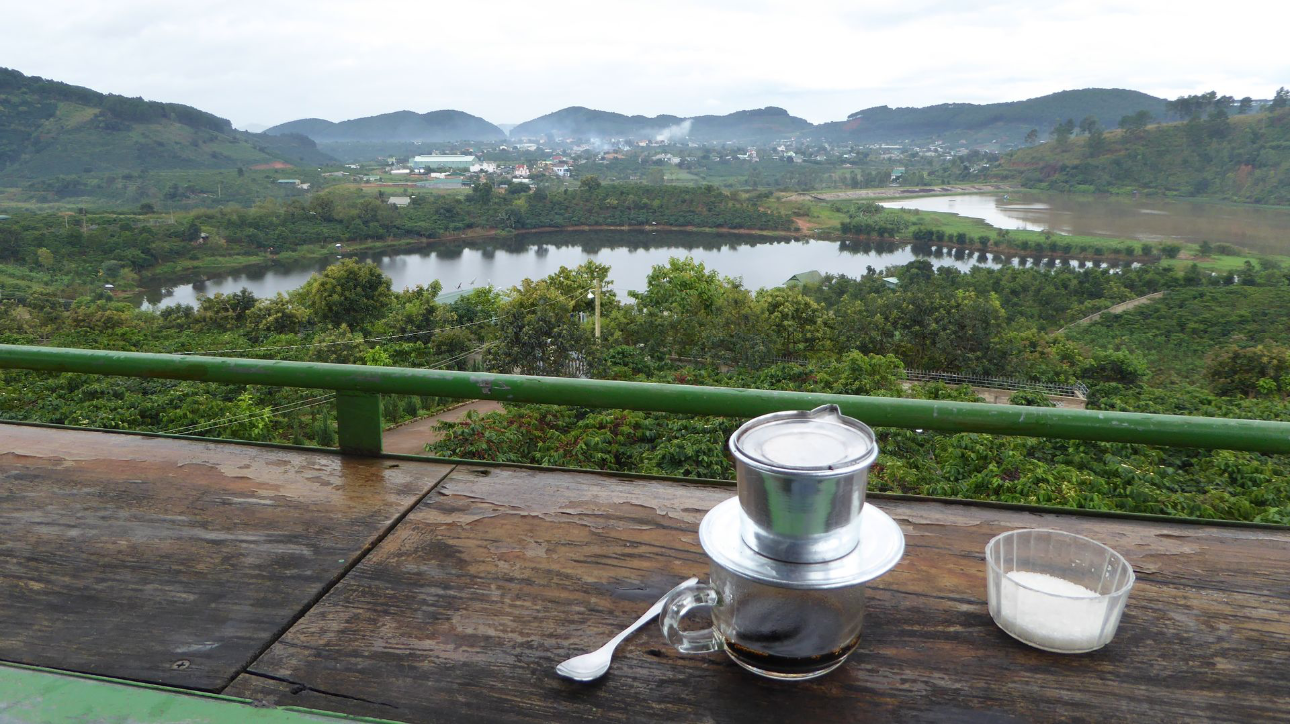
The cup we drink in the city carries within it an invisible chain of labor. The hands that prepared the soil, pruned the branches, picked the cherries by hand.
The white blossoms of the coffee trees, whose scent recalls honey. The beans dried in the sun on large mats, turned regularly for even fermentation.
When you understand where coffee comes from, you drink it differently: more slowly, with more presence.
Culture & society
Coffee as a social space
In Vietnam, coffee isn't ordered to go. You sit on a plastic stool, on a terrace by Hoan Kiem Lake, or in one of the cà phê cóc (literally "frog cafés," the tiny sidewalk stalls) that line every alley. Drinking coffee is inseparable from time spent doing nothing — or doing everything: reading, chatting, watching the scooters go by.
Vietnamese coffee doesn't try to resemble Roman espresso or Australian flat white. It is itself: intense, slow, rooted in everyday life, and capable of softening bitterness without ever denying it.
The Vietnamese phin isn't a tool of efficiency. It's an invitation to stay.
Hanoi has established itself as the undisputed capital of local coffee culture, with legendary spots like Café Giảng or The Note Coffee, whose walls are covered with messages from customers around the world. In Saigon, the pace is faster, the coffee icier, often drunk standing up before hopping back on a motorbike.
This culture has crossed borders with the Vietnamese diaspora. Today, Vietnamese specialty cafés are flourishing in Paris, London, Los Angeles, and Tokyo, carrying the phin and condensed milk as identity markers of a traveling cuisine.
Influence & challenges
Influence & challenges
Vietnam produces more than 50% of the world's Robusta and directly influences London futures prices. But more than 81% of exports leave as unprocessed green beans, leaving the added value to others. The industry still counts only four protected geographical indications (Gia Lai, Đăk Hà, Sơn La, Buôn Ma Thuột).
Climate change paradoxically strengthens Vietnam's position: while Arabica could decline by 50% by 2088 due to global warming, Vietnamese Robusta stands out as one of the most resilient varieties on the world market.
The specialty coffee scene is gaining momentum, with artisan roasters showcasing Arabica micro-lots from Dalat or Son La at premium prices — an upmarket shift that could transform the industry's economic model.
Well grown, well harvested and carefully roasted, Vietnamese Robusta is no longer just the strong coffee of industrial blends. It reveals a character of its own, an aromatic density that few varieties can offer. This is precisely what we champion here.
Go further
Bibliography & sources (French)
Vietnam: the coffee industry at a crossroads
French Treasury Directorate General · May 2024 · Economic analysis
Vietnamese coffee: the authentic flavor of life
Horizon Vietnam Travel · May 2026
Guide to Vietnamese coffee: cà phê sữa đá, egg coffee, coconut coffee
Vietnam Tourism · 2026
Vietnam: declining coffee production and sustainability challenges
Vu d'Ailleurs · April 2026
Michelin: egg coffee, a Hanoi masterpiece
Vietnam.vn / Michelin Guide · 2024
Coffee growing in Vietnam
Wikipedia · the free encyclopedia
Hanoi's egg coffee — cà phê trứng: recipe and history
La Maison du Vietnam · February 2025